Organizers: Split an Escape Room Payment Without Fronting the Cash

Yes, groups can split payment for an escape room booking, and most venues make it easy when you use the right method. Shareable payment links, QR codes, or individual ticket purchases let each person pay their own share directly, no group treasurer required. Just confirm full payment and waivers are done before you arrive. Skip that step and you risk a lobby standoff.
Table of Contents
- How Venues Usually Handle Group Payments
- Practical Ways to Split the Bill
- What to Confirm in the Venue’s Booking Policy
- Organizer Checklist: Collecting Everyone’s Share
- Common Payment Problems and How to Fix Them
- Codebusters Escape Room’s Take on Group Payments
- The Organizer’s Real Job Isn’t Collecting Money
- Book Your Group’s Room With a Payment Setup That Works
- Where to Learn More About Group Payment Tools
- Sources
- FAQ
How Venues Usually Handle Group Payments
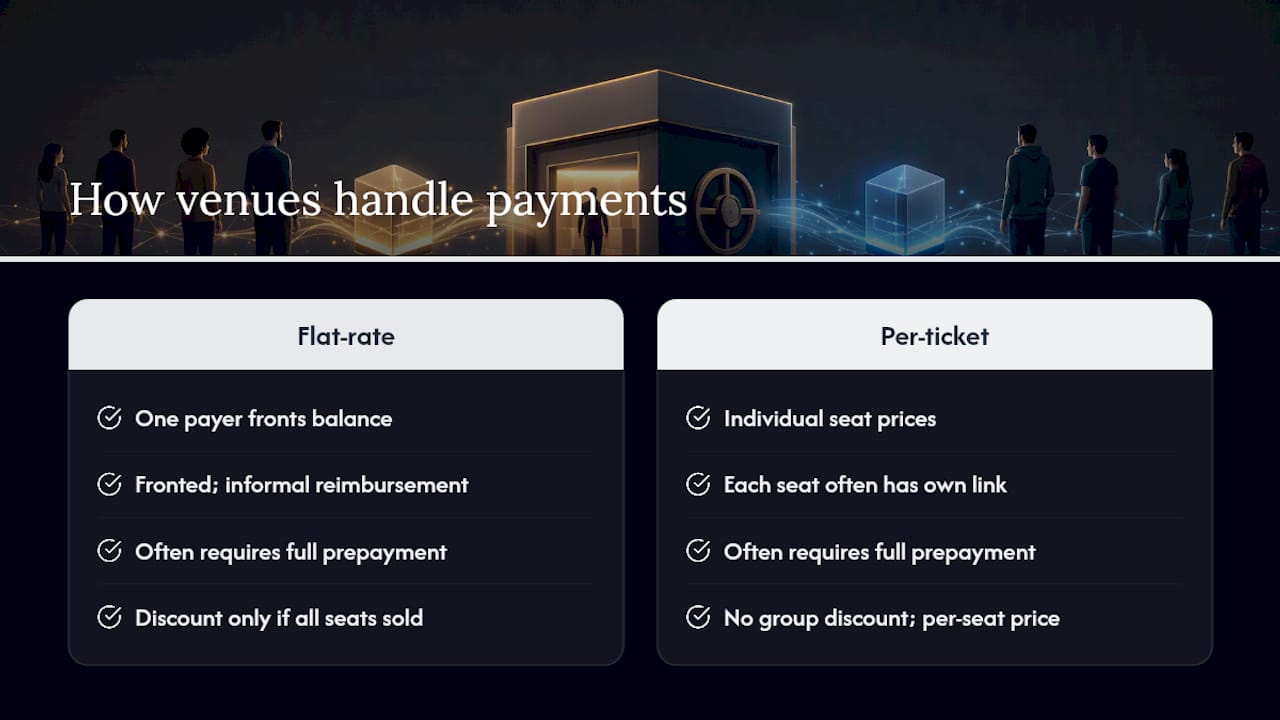
Most escape room venues price bookings one of two ways: a flat room rate for the whole group, or per-ticket pricing that scales with headcount. That distinction changes how split payment works in practice. A flat-rate room might require one person to pay the full balance up front, then reimburse themselves informally. Per-ticket pricing is friendlier to splitting because each seat has its own price tag and, often, its own checkout link.
Many venues also require full prepayment for group bookings rather than a small deposit, specifically because group bookings are harder to fill on short notice than solo walk-ins. Full-room discounts usually apply only when every seat sells and the whole booking clears at once. If three of six people pay and the rest stall, the venue may reprice the booking at standard per-person rates rather than honor the group discount.
Waivers add another layer. Digital waivers are frequently tied to the ticket itself, meaning the person who books that slot is the one legally on record for it. That’s part of why individual payment links matter: they connect payment and liability to the same person, not to whoever happened to swipe a card at the counter.
Practical Ways to Split the Bill
The cleanest method is a shareable payment link or QR code. The organizer books the room, then sends a link that lets each participant pay their own portion directly. Nobody fronts the group’s money, and the organizer isn’t stuck chasing five different Venmo requests after the fact. Some booking platforms build this in natively, generating a unique QR code so each participant pays instantly and the organizer watches payment status update in real time.
Peer-to-peer apps like Venmo or Cash App work too, but they come with friction. They’re fast for collecting money between friends, but the organizer still has to manually reconcile who paid, chase stragglers, and then pay the venue as one lump sum. That reintroduces the exact bottleneck a payment link avoids.
On-site card splits, where everyone hands their card to the front desk one at a time, work fine for small groups arriving together. They fall apart for larger parties or when people trickle in separately, since the venue needs the full balance settled before the briefing starts.
A few things to sort out before you pick a method:
- Decide even splits versus custom splits (some people bringing kids, others paying full adult price)
- Confirm who eats card processing fees, the organizer or each payer
- Check whether the venue’s booking platform supports individual claim links at all
Pro Tip: Ask the venue directly whether their booking system supports group claim links. If it doesn’t, a peer-to-peer app with a hard payment deadline is your backup plan, not your first choice.
What to Confirm in the Venue’s Booking Policy
Before you commit to a split-payment plan, get answers on a short list of policy questions. Skipping this step is how organizers end up covering costs they never agreed to.
- What’s the deposit or prepayment requirement, and is it refundable if someone cancels?
- What’s the cutoff for canceling or rescheduling without a penalty?
- Is there a minimum player count, and does the full-room discount require 100% payment?
- Can the venue accept multiple individual payments, or does it need one person to pay the total?
- Are digital waivers tied to individual tickets, or does one signature cover the group?
Some platforms enforce minimum and maximum player counts automatically and only unlock the discounted full-room rate once the manifest shows every seat sold and paid. That detail matters more than it sounds. If your group of six is counting on the six-person discount but only five people pay, you may get billed at the higher per-person rate instead. Codebusters Escape Room’s own guide to group booking in Colorado Springs covers similar ground for anyone planning a private-room event locally, and it’s worth a skim before you lock in a date.
Organizer Checklist: Collecting Everyone’s Share
Run the booking through this sequence and you’ll avoid nearly every payment headache groups run into.
- Book a room that supports group links or individual tickets. Not every listing does, so confirm before you pay a deposit.
- Set a firm payment deadline, ideally 48 to 72 hours before the booking date, giving the venue time to reconcile and handle any last-minute drop-outs.
- Send the payment link or QR code to the group, along with the waiver link and the deadline, in the same message.
- Track who’s paid and who’s signed in one simple manifest, whether that’s a spreadsheet or the venue’s own dashboard.
- Follow up directly with anyone who hasn’t paid at the 24-hour mark, not the night before.
- Decide your fallback in advance: will you cover a no-show’s share yourself, ask the group to absorb it, or request a partial refund from the venue?
Pro Tip: Pair the payment link with the waiver link from the start. Venues that track both together on one manifest can tell instantly who’s cleared for the briefing, which speeds up check-in for the whole group.
Common Payment Problems and How to Fix Them
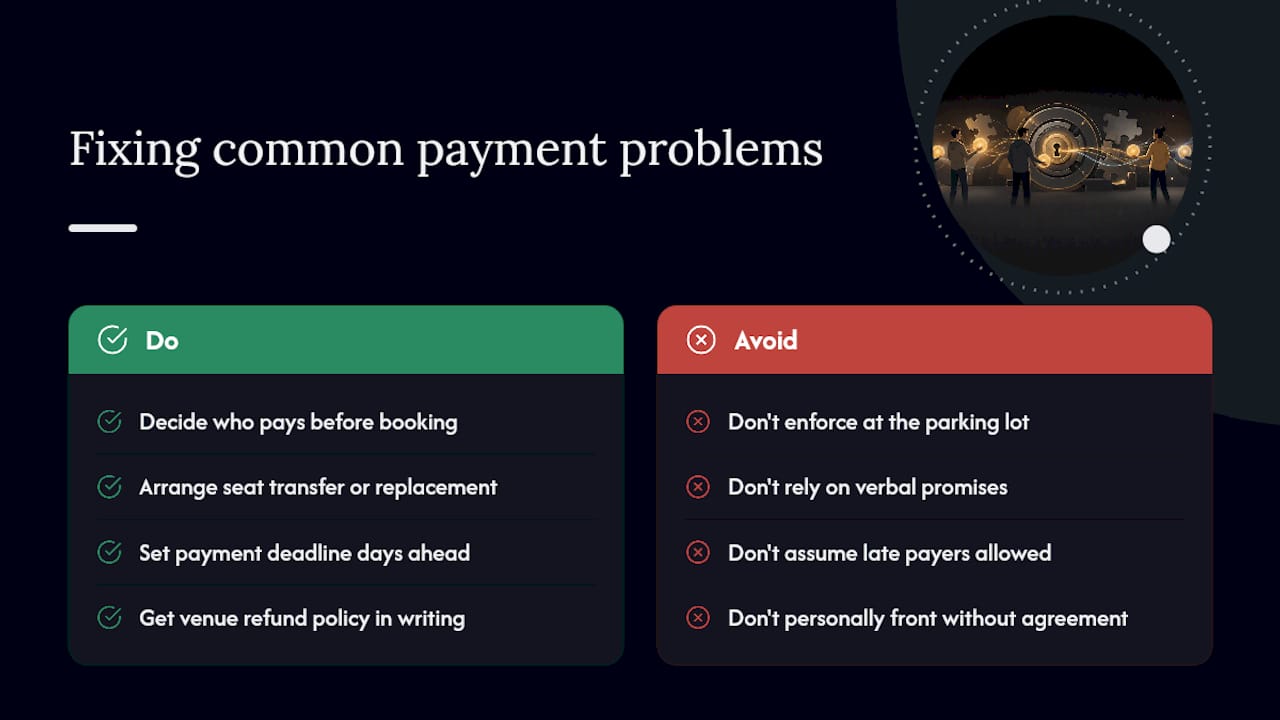
No-shows are the most common headache. If someone bails after paying, ask the venue about a refund policy or transferring that seat to a replacement player. If someone never pays at all, you have three real options: find a replacement, request a refund adjustment from the venue for the empty seat, or personally cover it and collect later. Decide which one you’re comfortable with before the booking, not during it.
Late payers at check-in are the second big issue. Some venues will deny entry to anyone who hasn’t completed payment, no exceptions, even if the rest of the group is ready to go. Set that expectation with your group days ahead of time, not in the parking lot.
Disputes over who owes what happen when splits aren’t clearly communicated up front. Keep receipts and text threads, and ask the venue for its refund policy in writing rather than relying on a verbal promise at the counter.
Codebusters Escape Room’s Take on Group Payments
Codebusters Escape Room books private rooms for every group, which means your party isn’t merged with strangers, and payment logistics stay contained to your own group. Our routine for larger bookings pairs a group payment link with digital waivers and a single confirmation manifest, so we can see who’s paid and who’s signed before anyone walks in the door.
Requiring prepayment or a shareable link up front consistently reduces the odds that one organizer gets stuck covering a no-show. It also cuts down on lobby confusion, since everyone shows up already confirmed rather than sorting out who owes what at the counter.
The Organizer’s Real Job Isn’t Collecting Money
Most advice on splitting an escape room bill focuses on which app moves money fastest. That’s the wrong starting point. The real risk isn’t payment speed, it’s ambiguity: nobody agreeing in advance on who covers a no-show, what happens if someone cancels late, or whether the discount holds if one person’s payment is late.
Venmo and Cash App are fine tools, but they don’t solve the actual problem, which is coordination, not transfer speed. A payment link tied to a manifest solves it because it makes status visible to everyone, not just the organizer.
If you organize group outings regularly, the habit worth building isn’t “find the best splitting app.” It’s “always confirm the venue’s payment structure and deadline before you tell your group it’s booked.” That single habit prevents almost every payment dispute this article covers.
— CodeBusters
Book Your Group’s Room With a Payment Setup That Works
Codebusters Escape Room keeps every booking private, so your group’s payment logistics never get tangled up with another party’s. We offer multiple themed rooms sized for various group sizes, and we work directly with organizers to coordinate group payments so nobody gets stuck fronting the bill.
If you’re organizing a group outing, a birthday party, or a corporate team-building session, browse the full lineup of rooms and book online, or contact us directly and we’ll walk you through the group payment process before you commit to a date. It costs nothing to ask.
Where to Learn More About Group Payment Tools
For readers who want the platform-level mechanics, Passage’s ticketing and payment features and Wakesys’s waiver and booking software both document how group claim links and manifests work behind the scenes.
Sources
- Passage - Unlock All-in-One ticketing & Payments
- SchedulingKit — Payments for escape rooms
- Vorion — Group payments made simple
- Wakesys — Escape room booking & waiver software
FAQ
Are Escape Rooms Cheaper With More People?
Often, yes. Many venues price by the room rather than per person, so a larger group splits the same total cost into smaller individual shares. That discount typically only applies once every seat is paid in full, so a partially paid group may get billed at standard per-person rates instead.
How Much Does an Escape Room for 5 People Cost?
It depends on the venue and room, since pricing varies by theme and difficulty level. Codebusters Escape Room’s current room prices are listed on the rooms page, and per-person rates typically drop once a group books enough seats to unlock a full-room rate.
Is 2 People Enough for an Escape Room?
It depends on the room’s minimum player count, which varies by venue and difficulty. Some rooms are designed for pairs, while others need a minimum of three or four players to make the puzzles solvable in the time limit, so check the specific room’s requirements before booking.
How Much Do Escape Rooms Charge?
Pricing depends on the venue, room theme, and group size, with most charging either a per-person rate or a flat room rate. Full-room discounts usually apply only when the entire group’s payment clears together, which is one reason venues increasingly favor group claim links over one person fronting the whole balance.
What Happens if Someone in My Group Doesn’t Pay Their Share?
Most venues will hold the booking open until full payment clears, and some deny entry to anyone with an outstanding balance at check-in. Decide ahead of time whether you’ll find a replacement, request a partial refund, or personally cover the gap, since sorting that out during check-in creates unnecessary stress for the whole group.