Escape Room Deposit: What $25–$100 Holds at CodeBusters
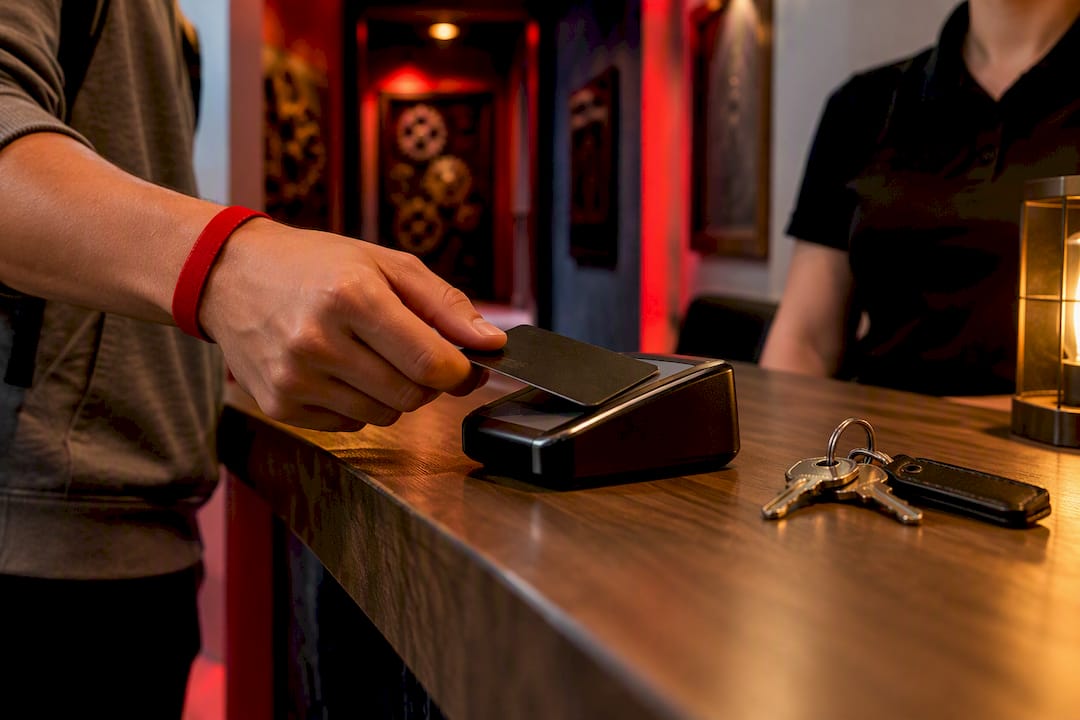
Yes, you’ll almost always put down a deposit to book an escape room, and it exists to hold your time slot against no-shows and last-minute cancellations. Most venues use one of three models: a small per-person token, a flat per-room fee, or a percentage of the total booking. Whether you see that money again depends entirely on how much notice you give before your scheduled game.
Table of Contents
- Why Escape Room Deposits Exist in the First Place
- How Much Is an Escape Room Deposit, Really?
- Will You Get Your Deposit Back If Plans Change?
- What Payment Methods Do Escape Rooms Actually Accept?
- Deposit Rules for Private Bookings and Corporate Events
- How to Protect Your Deposit and Lock In Your Booking
- How Codebusters Escape Room Handles Deposits
- Ready to Lock In Your Booking?
- Sources
- FAQ
Why Escape Room Deposits Exist in the First Place
A deposit is different from a booking fee, and both are different from full prepayment. A deposit is a partial payment held against your reservation. A booking fee is a smaller, often non-refundable charge just to process the reservation itself, sometimes stacked on top of a deposit. Full prepayment means you pay the entire session cost upfront, with the “deposit” language dropped entirely.
Venues require some form of advance payment for a few practical reasons:
- It holds a private time slot that another group can no longer book.
- It reduces the odds of a no-show, since walking away from real money is a better incentive than walking away from a free reservation.
- It secures the room exclusively for private bookings, where the venue is turning away every other potential group for that hour.
Most booking flows now handle this automatically. Online reservation platforms like Bookeo let venues authorize a card, charge a flat deposit, or run a percentage calculation the moment you hit “confirm,” so you typically know the exact number before you ever speak to a staff member.
How Much Is an Escape Room Deposit, Really?
Three pricing structures dominate the industry, and each behaves differently depending on group size and demand.
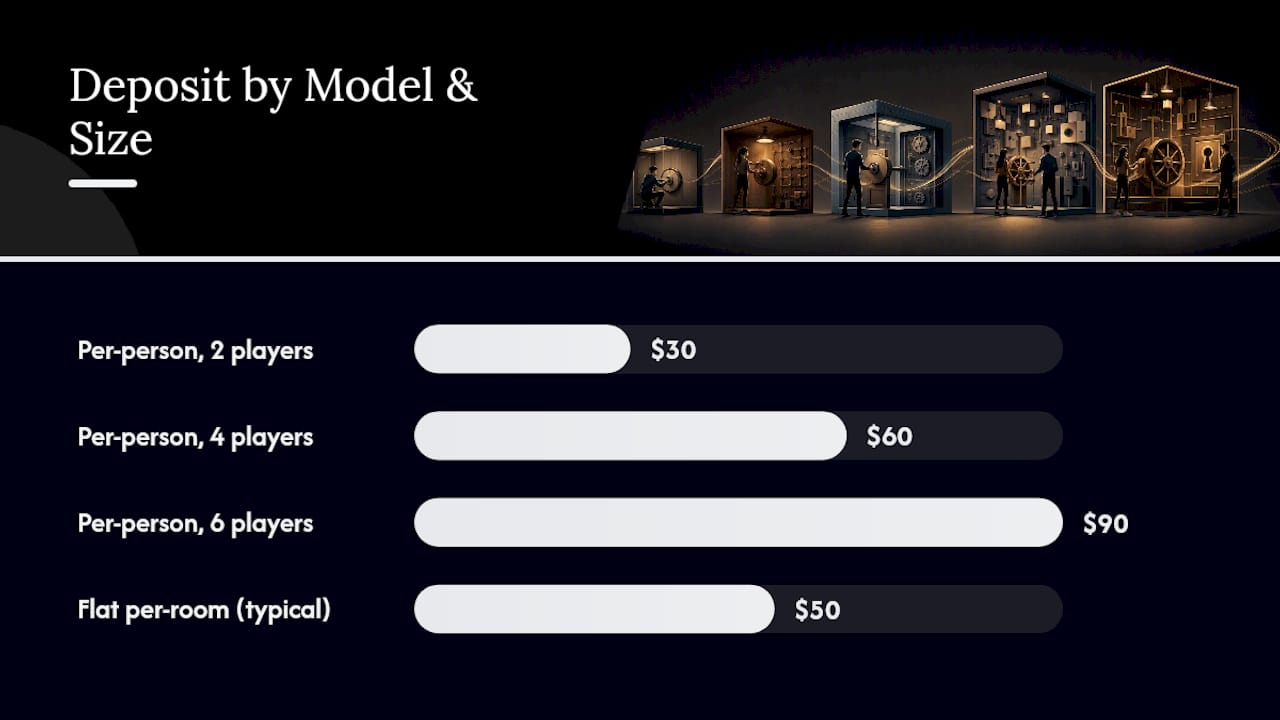
- Per-person token deposits. Common at larger or walk-in-friendly venues, these run roughly $5 to $20 per person, collected to confirm each seat in the group.
- Flat per-room deposits. Smaller venues often prefer a single flat charge for the whole room, typically $25 to $100 regardless of how many players show up.
- Percentage-based deposits. High-demand slots, holidays, or special event rooms sometimes require 20% to 30% of the total booking cost upfront.
Here’s what that looks like for a typical four-player booking. Under a per-person model at $15 a head, you’re putting down $60. Under a flat per-room fee of $50, the group total stays fixed no matter who shows up.
Pro Tip: Ask which model applies before you book if your group size might change. A per-person deposit scales with headcount changes; a flat fee usually doesn’t, which can work in your favor if a few extra friends decide to join.
Will You Get Your Deposit Back If Plans Change?
Refund policies vary more than almost any other part of the booking process, and this is where most deposit disputes start. Broadly, you’ll run into three structures.
- Non-refundable. The deposit is gone once paid, no matter the reason for canceling.
- Refundable with notice. You get your money back, or most of it, if you cancel before a set deadline.
- Transferable credit. Instead of a refund, the venue lets you apply the amount to a future booking.
Notice windows differ by venue. Some allow same-day rescheduling with no penalty. Others set a 24 to 72 hour cutoff, and a smaller group of venues use tiered windows, such as a full refund at 21 days out, partial credit at 7 days, and forfeiture inside that. Private bookings and parties usually carry stricter rules than a standard walk-in reservation, since the venue has blocked off the entire room and turned away other business for that slot. Always check the specific cancellation policy for the venue you’re booking, and get any promised exception in writing rather than a verbal assurance.
What Payment Methods Do Escape Rooms Actually Accept?
Card payments dominate the online booking process, and most venues also accept cash if you’re paying in person.
- Online bookings typically require a credit or debit card at checkout, either for the deposit itself or to keep on file for the remaining balance.
- Walk-in and day-of payments often accept cash alongside card options, though online reservations lean toward card-only for the deposit.
- Gift vouchers can usually be applied toward a deposit or the full balance, but confirm this before you rely on one to cover the upfront charge.
Whatever you pay, ask for a confirmation email or receipt and check exactly what it says the payment covers. A deposit receipt and a “paid in full” receipt look similar at a glance, and that distinction matters if a dispute ever comes up later.
Deposit Rules for Private Bookings and Corporate Events
Group events almost always carry heavier financial guarantees than a standard reservation, because the venue is committing an entire room and staff schedule to your party. Expect a flat per-room deposit, a minimum headcount guarantee, and possible add-on fees for food, decorations, or extended time.
- Corporate and party bookings frequently require a locked-in minimum guest count, meaning you’ll pay for that number even if fewer people show up.
- Headcount increases are usually easy to accommodate; decreases close to the date often aren’t refunded.
- Final balances are typically due at check-in, though some venues require full payment days in advance for large private events.
Pro Tip: Get every agreed change, especially headcount adjustments and payment deadlines, confirmed in writing by email. Verbal promises from a phone call don’t hold up if there’s a mix-up on event day. For a deeper look at how private-event terms typically work, this guide to private bookings breaks down what organizers should confirm before paying anything. Other group activity venues follow similar logic, including private-event spaces like Archers Battlefield, which structures its own room deposits as guarantees rather than casual holds.
How to Protect Your Deposit and Lock In Your Booking
A handful of habits separate the people who get their money back from the people who lose it over a scheduling mix-up.
- Book early, especially for weekends and holidays, and save your confirmation email the moment it arrives.
- Read the cancellation and reschedule deadlines before you pay, not after, so you’re not guessing on the day you need to change plans.
- Choose a private booking if exclusivity matters to your group, and confirm the payment terms for larger parties before the day of the event.
- Contact the venue immediately if your plans change. Most reschedule requests are handled far more smoothly with a few days’ notice than a same-day scramble.
- If a venue makes a verbal exception to its stated policy, ask for it in writing before you rely on it.
Pro Tip: Set a calendar reminder two days before your reschedule deadline expires. It’s the single easiest way to avoid losing a deposit to a forgotten cutoff. For groups navigating headcount changes specifically, this guide to group booking in Colorado Springs covers timing details worth reviewing before you finalize numbers.
How Codebusters Escape Room Handles Deposits
We treat a deposit as a two-way commitment: you’re holding a slot, and we’re holding a room exclusively for you. The venue publishes its cancellation and reschedule policy openly rather than burying it in fine print, and the private booking format means every reservation gets the same clear terms up front. If your situation falls outside a standard case, a quick call before your scheduled time solves more problems than waiting until after.
— CodeBusters
Ready to Lock In Your Booking?
Once you know what a deposit protects, the smartest move is checking the current terms before you commit to a date. The venue keeps deposit and payment details visible right on the booking flow, not hidden behind a phone call, so you know exactly what you’re paying and when the balance is due. That’s the real advantage over guessing at policies from a generic FAQ page: you see your specific room, your specific group size, and your specific payment terms before you hand over a card number.

Browse current availability and deposit details on the rooms page, where every themed experience, from Colorado Jones to Wizard’s Academy, lists its own booking options. Planning a party or corporate event? Reach out directly so we can confirm headcount guarantees and payment deadlines before you lock in a date. If you’re buying for someone else, gift vouchers are also available and can typically be applied toward a booking.
FAQ
How Much Do You Have to Pay for an Escape Room Deposit?
It depends on the model the venue uses. Per-person deposits typically run $5 to $20 per player, while flat per-room deposits usually fall between $25 and $100, and percentage-based models can require 20% to 30% of the total booking upfront.
Why Are Escape Rooms Priced Per Person Instead of Per Room?
Per-person pricing lets venues scale the cost with actual attendance, which matters most at larger sites that run mixed public and private groups. Many smaller or fully private venues price by the room instead, so the group pays one flat rate no matter how many people show up within the room’s capacity.
Do You Tip After an Escape Room?
Tipping isn’t required, but it’s a common courtesy if a game master actively hosted your session, gave hints, or made the experience notably fun. A few dollars per person is typical when guests choose to tip, similar to tipping at other guided entertainment experiences.
How Much Time Do You Get Inside an Escape Room?
Most escape rooms run 60 minutes, though some themed or advanced rooms extend slightly longer depending on the puzzle design. Your booking confirmation will specify the exact time limit for your particular room.
Can I Get My Escape Room Deposit Back If I Need to Cancel?
It depends entirely on the venue’s policy and how much notice you give. Some deposits are non-refundable outright, others are refundable if you cancel before a set window such as 24 to 72 hours, and many venues offer credit toward a future booking instead of a straight refund. Always check the specific cancellation policy for your venue before assuming either outcome.