The Role of Escape Rooms in Onboarding Teams

Escape room training is defined as a structured, game-based learning method that places new hires inside timed, puzzle-driven scenarios to build collaboration and decision-making skills from day one. The role of escape rooms in onboarding goes far beyond entertainment. These experiences replace passive slide decks with active problem-solving, giving HR professionals a tool that accelerates trust, surfaces natural leaders, and embeds company culture before a new hire ever sits at their desk. Research confirms that active participation in escape rooms drives team cohesion in ways that traditional orientation sessions simply cannot replicate.
How escape rooms create immersive learning environments
Escape rooms shift onboarding from passive reception to active engagement. Where a standard orientation asks new hires to absorb information, an escape room forces them to apply it under pressure. That distinction matters because application produces retention, while passive listening produces forgetting.

The format works across industries and complexity levels. Cybersecurity teams use escape room scenarios to teach threat recognition and incident response. Medical training programs at institutions like the University of Exeter have used escape rooms to prepare students for ward environments, with participants completing two-room challenges in about 40 minutes before entering clinical settings. The pressure of a ticking clock mirrors real workplace urgency without real-world consequences.
Session design follows a consistent pattern that HR teams can replicate. Onboarding escape rooms typically run 40–60 minutes with teams of 6–10 participants. That size is deliberate. Smaller groups force every person to contribute. Larger groups allow passengers who coast without engaging. A 2026 study on virtual escape room training among 20 participants showed enhanced enthusiasm and knowledge retention on complex topics like cybersecurity, confirming that the format works even outside a physical room.
Key learning outcomes from escape room training include:
- Decision-making under pressure: Participants practice prioritizing tasks when time is short.
- Communication clarity: Teams must share information quickly and accurately to progress.
- Role recognition: Natural leaders, detail-oriented thinkers, and creative problem-solvers reveal themselves organically.
- Knowledge application: Concepts introduced in pre-work or briefings get tested immediately in context.
Pro Tip: Customize at least two puzzles per session to reflect your company’s actual workflows or terminology. A puzzle built around your internal ticketing system or product naming conventions does double duty: it teaches the tool and reinforces the culture.
Why escape rooms accelerate collaboration and early trust
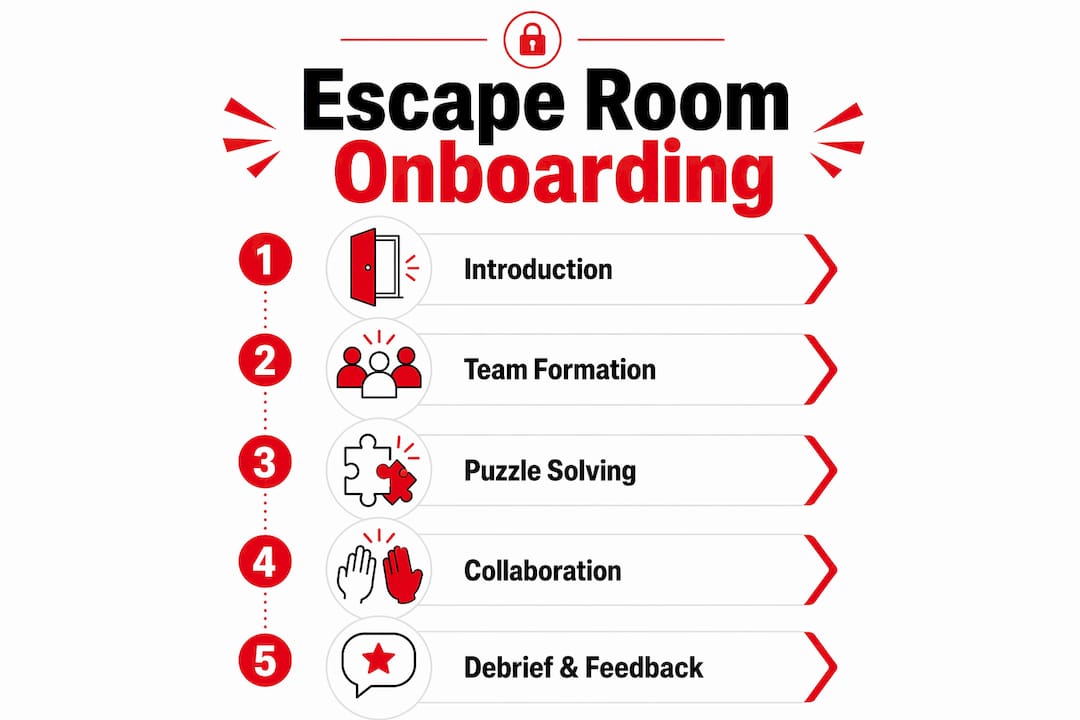
The group problem-solving format of an escape room creates conditions that normal office interactions rarely produce in the first week. New hires across seniority levels must communicate directly, ask for help, and accept input from peers they met hours ago. That dynamic compresses weeks of relationship-building into a single session.
Escape rooms create a psychological “change of space” that encourages comfortable experimentation among new hires across seniority levels. The game context removes the social risk of being wrong. A new hire who would hesitate to challenge a senior colleague in a meeting will freely disagree in a puzzle room because the stakes feel lower. That openness is exactly what early onboarding needs to generate.
Running escape rooms with an entire induction cohort produces another benefit: shared memories that build lasting camaraderie beyond the initial session. Teams that solve a problem together have a reference point. They reference it in meetings, in Slack channels, and in hallway conversations. That shared story becomes the foundation of team identity.
The following interactions emerge consistently when escape rooms are used in onboarding:
- Peer mentorship: More experienced participants naturally guide newer ones through unfamiliar puzzle types, mirroring real workplace dynamics.
- Cross-functional communication: Participants from different departments must explain their reasoning in plain language, building habits that carry into daily work.
- Conflict resolution: Disagreements about puzzle approaches surface and resolve quickly, giving teams low-stakes practice in navigating differences.
- Inclusive contribution: Quieter team members often shine in escape rooms because puzzles reward observation and pattern recognition, not just verbal confidence.
- Collective accountability: The shared timer creates a sense of mutual responsibility that reinforces team over individual thinking.
Pro Tip: Assign a facilitator to observe, not participate. Their job is to note which team members lead, which ones disengage, and where communication breaks down. That data feeds directly into your post-session debrief and informs early coaching conversations.
Best practices for implementing escape rooms in corporate onboarding
Effective implementation depends on three decisions made before the session starts: group composition, session length, and the facilitator’s role. Get these right and the experience delivers. Get them wrong and you have an expensive icebreaker that nobody remembers.
Group composition should mix new hires with at least one or two existing team members when possible. That mix creates natural mentorship moments and gives new hires an immediate connection to someone who knows the organization. Pure new-hire cohorts work well for building peer bonds but miss the opportunity to connect newcomers to institutional knowledge.
Physical vs. virtual escape rooms
Both formats deliver results. The right choice depends on your team’s location and your onboarding timeline.
| Feature | Physical escape rooms | Virtual escape rooms |
|---|---|---|
| Team size | 6–10 per room | Up to 10 per breakout group |
| Location requirement | On-site or venue-based | Remote or hybrid |
| Customization | High, with set design and props | High, with digital puzzle design |
| Scalability | Limited by physical space | Scales globally across time zones |
| Debrief format | In-person, immediate | Video call, structured agenda |
| Best for | Local cohorts, culture immersion | Distributed teams, remote onboarding |
Virtual and hybrid escape rooms enable global onboarding for remote teams using facilitator-led breakout groups of around 10 people. Companies that implemented these sessions in 2026 reported early connections forming across roles and seniority levels, even among teams that had never met in person.
Post-session reinforcement is where most onboarding programs fall short. Follow-up exercises and structured debriefs prevent knowledge fade after the initial session. Without them, the energy of the escape room dissipates within days. Effective reinforcement includes a 30-minute debrief immediately after the session, a written reflection prompt sent within 24 hours, and a follow-up check-in at the 30-day mark that references specific moments from the session.
Additional implementation practices that HR teams should build into their programs:
- Schedule escape rooms within the first three days of onboarding, not the first week’s end.
- Brief participants on the learning objectives before the session, not just the game rules.
- Record facilitator observations and share them with direct managers within 48 hours.
- Rotate room themes across quarterly onboarding cohorts to keep the experience fresh for returning facilitators.
How escape rooms embed organizational culture into onboarding
Generic escape rooms entertain. Customized escape rooms teach. That distinction separates programs that new hires remember from programs that fade by the end of the first month.
Custom narratives and puzzles help employees internalize organizational values during training in ways that a values poster on a wall never will. A puzzle that requires players to follow your company’s actual approval process teaches that process through action. A scenario built around a real client challenge your team faced teaches both the solution and the company’s problem-solving culture simultaneously.
The contrast between off-the-shelf and customized escape rooms is significant:
- Off-the-shelf rooms use generic themes (heist, mystery, sci-fi) that entertain but carry no organizational meaning.
- Customized rooms use company-specific narratives, internal terminology, and real process simulations that reinforce culture from the first hour.
- Hybrid approaches take a commercial room structure and layer in company-specific puzzle content, balancing cost with relevance.
Effective thematic integration examples include simulating a customer escalation scenario using your actual support protocols, building a puzzle around your product’s core features, or recreating a historical company challenge that defined your culture. Each approach gives new hires context that no handbook can provide.
Pro Tip: Interview two or three long-tenured employees before designing your escape room. Ask them what they wish they had understood in their first week. Their answers will generate your best puzzle concepts and reveal the cultural knowledge that never makes it into formal documentation.
Key Takeaways
Escape rooms are the most effective experiential onboarding tool available to HR professionals because they combine active learning, team bonding, and cultural immersion in a single, time-efficient session.
| Point | Details |
|---|---|
| Session structure matters | Run sessions of 40–60 minutes with 6–10 participants to maximize engagement and contribution. |
| Customization drives culture | Tailor puzzles to company workflows and values rather than using generic game mechanics. |
| Reinforcement prevents fade | Follow every session with a structured debrief and a 30-day check-in to sustain learning. |
| Virtual formats scale globally | Facilitator-led breakout groups of around 10 people make remote onboarding equally effective. |
| Shared experience builds identity | Running escape rooms with full induction cohorts creates lasting team bonds and shared reference points. |
What I’ve learned from watching teams go through escape rooms
Most HR programs treat onboarding as information transfer. Escape rooms expose that assumption as wrong. What new hires actually need in their first days is not more information. They need a reason to trust the people around them and a safe place to show who they are.
The teams I’ve seen come through immersive escape room experiences at Codebustersescaperoom leave with something that no slide deck produces: a story. They have a moment they shared, a problem they solved together, and a memory that belongs to the group. That story becomes the first thread of team culture.
The most common mistake I see is deploying an escape room as a standalone event with no follow-up. The session generates energy. The debrief converts that energy into learning. Skip the debrief and you’ve wasted half the investment. The second mistake is choosing a room that has nothing to do with the company’s actual work. A pirate-themed room is fun. A room built around your company’s real challenges is transformative.
My recommendation is to blend escape room training with at least one other collaborative team building activity in the first week. The escape room opens people up. A structured project or workshop the next day channels that openness into real work. Together, they produce onboarding outcomes that neither achieves alone.
— CodeBusters
Codebustersescaperoom: built for corporate teams in Colorado Springs
Codebustersescaperoom designs immersive, themed experiences that corporate teams use for onboarding, training, and team building. Located in Colorado Springs and veteran-family owned, Codebustersescaperoom offers private room bookings across multiple themed rooms, including “Past to the Future,” “Stranger 80’s,” and “Flight of Deception,” each built for different group sizes and difficulty levels.
HR professionals looking to add a high-impact experiential element to their onboarding programs can book a private session for their incoming cohort. Codebustersescaperoom’s rooms accommodate groups of varying sizes, and the private booking format means your team gets the full experience without outside participants. Gift vouchers are also available for teams that want to schedule sessions across multiple onboarding cohorts throughout the year.
FAQ
What is the role of escape rooms in onboarding?
Escape rooms in onboarding replace passive orientation sessions with active, collaborative problem-solving that builds trust and communication skills from day one. They give new hires a shared experience that accelerates team bonding and cultural assimilation.
How long should an onboarding escape room session last?
Onboarding escape room sessions typically run 40–60 minutes, which allows multiple cohorts to complete sessions in a single day. That duration is long enough to generate meaningful team interaction without consuming a full day of onboarding time.
Can escape rooms work for remote or hybrid onboarding?
Virtual escape rooms use facilitator-led breakout groups of around 10 participants and scale across time zones, making them effective for distributed teams. Companies using this format report early relationship-building across roles and seniority levels even among teams that have never met in person.
What team size works best for escape room training?
Groups of 6–10 participants produce the best results because every person must contribute actively. Larger groups allow disengagement, while smaller groups may lack the diversity of thinking that makes collaborative problem-solving effective.
How do you sustain the impact of escape room onboarding?
Structured debriefs and follow-up exercises after the session prevent knowledge fade and convert the experience into lasting behavioral change. A 30-day check-in that references specific moments from the session reinforces both the learning and the team relationships formed during the activity.