Escape Room Mixed Age Group Tips for Every Family
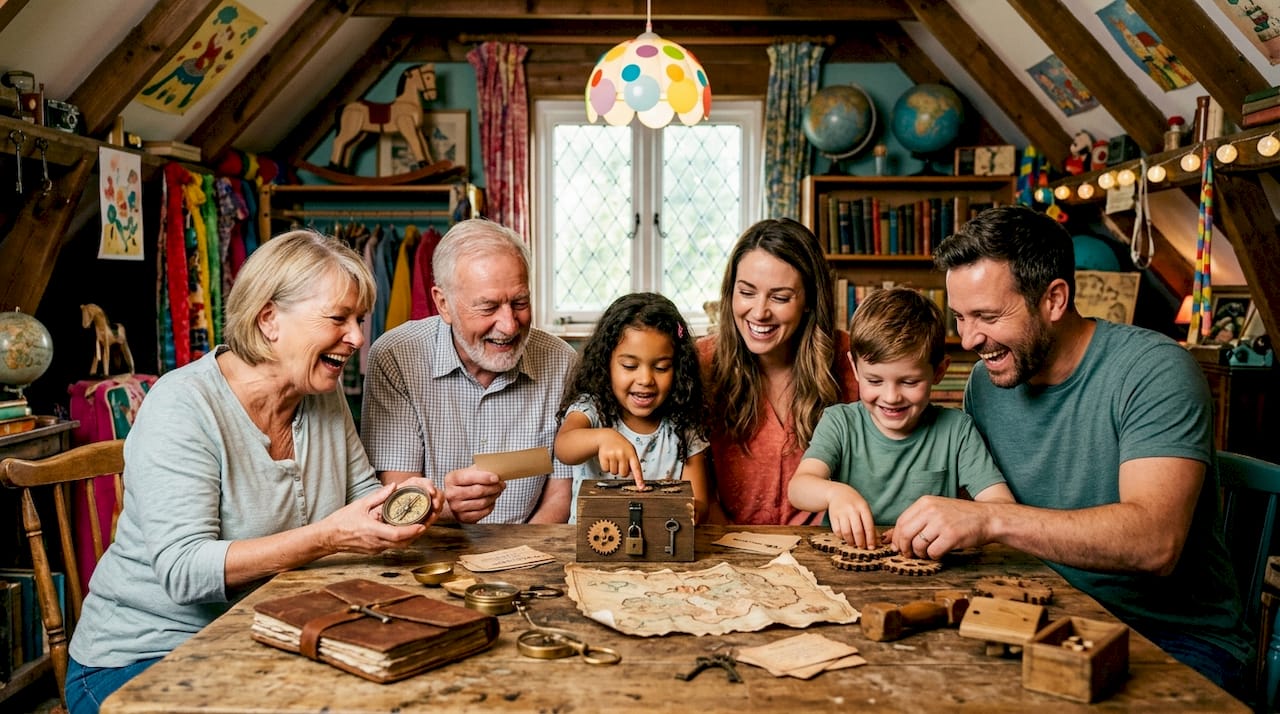
Mixed-age escape rooms are defined as group puzzle experiences designed to engage players across at least two distinct age brackets, typically children and adults, within a single shared session. Getting this right requires more than just booking a room. The best escape room mixed age group tips center on three decisions made before you ever walk through the door: room difficulty, group composition, and role assignment. Family-friendly sessions run 30–60 minutes and suit groups of 3–6 players, with shorter sessions of 15–25 minutes recommended for children ages 6–9. A balanced group of 2–3 kids aged 10 and older plus 2–3 adults consistently outperforms groups skewed heavily toward younger children. These numbers are not arbitrary. They reflect how attention spans, physical stamina, and puzzle reasoning actually distribute across ages.
What are the best escape room mixed age group tips for room selection?
The single most important decision in planning a mixed-age escape is choosing the right room. Difficulty and theme determine whether every player stays engaged or whether one age group carries the entire session.
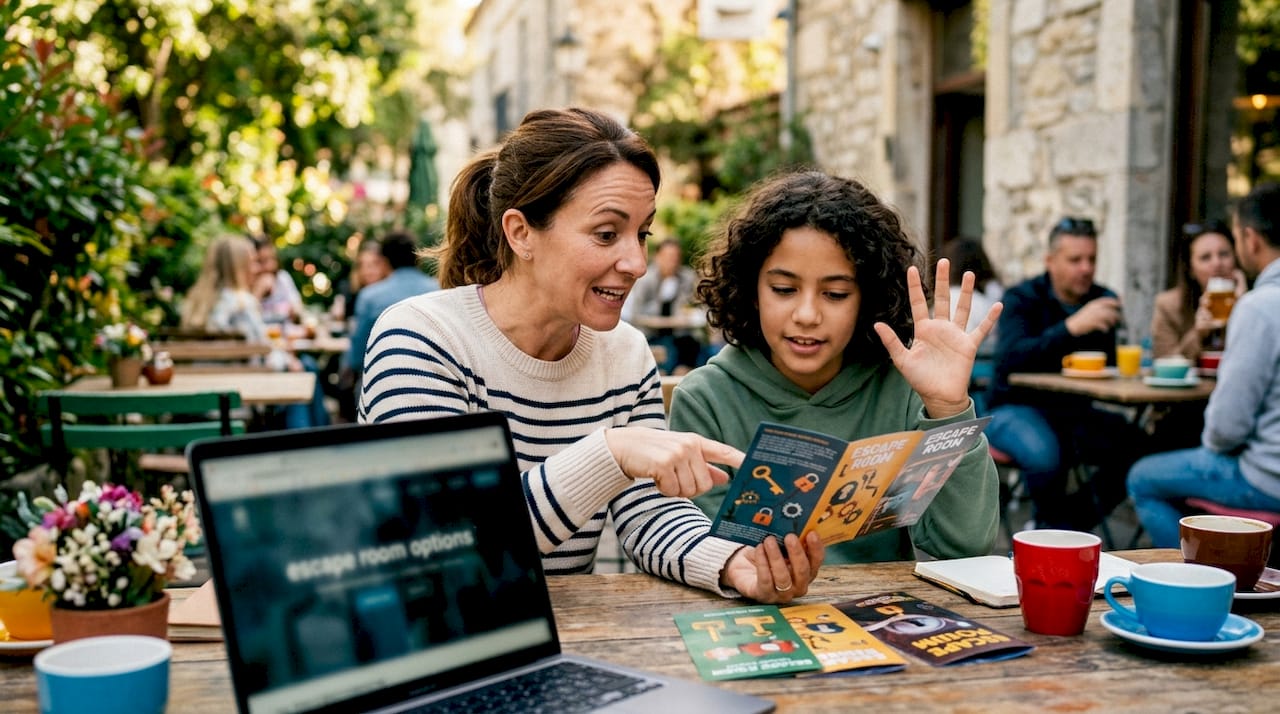
Choose easy to medium difficulty rooms when your group includes children under 12. Age is secondary to enthusiasm for escape room success, which means a well-chosen room at the right difficulty level lets a motivated eight-year-old outperform a bored adult. That insight reframes the selection process entirely. You are not picking a room that challenges your strongest player. You are picking one that keeps your least experienced player in the game.
Theme matters as much as difficulty. Avoid high-scare content, graphic narratives, or horror themes when children are in the group. Broadly appealing themes like adventure, mystery, or science fiction give every player a reason to care about the story. Rooms built around exploration rather than fear create the psychological safety younger players need to contribute freely.
Look for rooms with scaffolded puzzles and built-in operator hints. Scaffolded puzzles layer complexity gradually, so a child can solve the first step while an adult handles the final logic. Operator hints prevent the group from stalling on a single puzzle for too long, which is the fastest way to lose a younger player’s attention. When reviewing your options, check difficulty level guides to match the room to your specific group composition.
Key criteria for room selection in mixed-age groups:
- Difficulty: Easy to medium, with a clear progression from simple to complex puzzles
- Theme: Adventure, mystery, or science fiction rather than horror or mature content
- Puzzle structure: Scaffolded design that allows parallel solving across skill levels
- Session length: 30–60 minutes for groups with children aged 10 and older; 15–25 minutes for ages 6–9
- Group size: 3–6 players for the best balance of participation and manageability
- Hint system: Rooms with accessible, responsive hint systems keep momentum alive
How does teamwork and communication affect mixed-age group success?
Silent teams fail more often than vocal ones. Assigning explicit roles like clue collector, timekeeper, or puzzle organizer keeps every player active and prevents the common pattern where adults solve everything while children watch.
Role assignment works because it gives each player a defined contribution. A child assigned as clue collector has a job to do from the first minute. That job keeps them scanning the room, touching objects, and calling out discoveries. Adults assigned to puzzle organization translate those raw discoveries into solutions. The two roles are genuinely interdependent, which is exactly what you want.
Verbalization is the single most effective success factor in any escape room. Teams that broadcast every clue immediately outperform those working silently, because shared information prevents duplicated effort and surfaces connections faster. This is especially true in mixed-age groups, where a child may notice a visual pattern that an adult overlooks entirely.
- Assign roles before entering the room. Decide who collects clues, who tracks time, and who organizes found items. Do not leave this to chance once the clock starts.
- Establish a “say it out loud” rule. Every player announces every discovery immediately, no matter how trivial it seems.
- Spend the first 3–5 minutes on a full room search. Teams that search collectively before solving puzzles avoid tunnel vision and duplicated effort.
- Rotate attention. If one player has been stuck on a puzzle for more than two minutes, call another player over. Fresh eyes solve faster.
- Acknowledge every contribution. When a child finds a clue that unlocks a puzzle, name it. That recognition keeps younger players motivated through the full session.
Pro Tip: Before the session starts, tell every child in the group that their job is to find things adults miss. Children take this seriously, and it produces real results.
How do different ages solve puzzles differently in escape rooms?
Mixed-age groups carry a natural cognitive advantage that most families never use deliberately. Children excel at pattern recognition and associative thinking, while adults bring structured logic and patience with complex sequences. Puzzles that require raw perception feeding into adult reasoning are the most effective for multi-generational teams.
Cognitive strengths by age group
Children tend to notice visual anomalies, color patterns, and spatial relationships faster than adults. Their associative thinking connects seemingly unrelated objects in ways that linear adult reasoning often skips. Adults bring experience with cipher logic, sequential reasoning, and the patience to work through multi-step problems without losing focus.
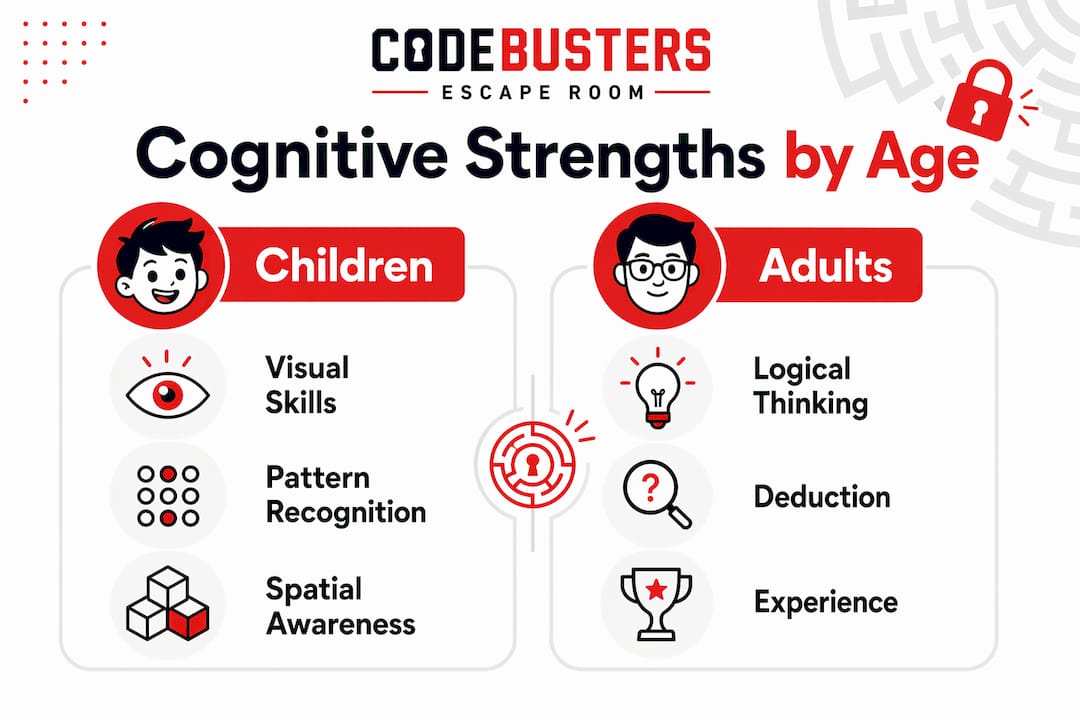
The practical application is straightforward. Let children lead the observation phase. Let adults lead the deduction phase. A child who spots that three symbols on the wall match three objects in the room has done the hardest perceptual work. An adult who then maps those objects to a combination lock completes the chain. Neither could do it as well alone.
What puzzle types work best for mixed-age groups?
| Puzzle type | Best suited for | Why it works across ages |
|---|---|---|
| Visual pattern matching | Children lead, adults verify | Rewards keen observation and quick pattern recognition |
| Sequential logic puzzles | Adults lead, children assist | Builds on experience with ordered systems |
| Physical search tasks | All ages equally | Requires no prior knowledge, rewards thoroughness |
| Cipher and code breaking | Adults lead | Patience and prior exposure to letter/number systems |
| Sound or light feedback puzzles | Children lead | Immediate sensory feedback maintains flow state for kids |
Puzzles with immediate visual or auditory feedback keep younger players in flow state, while logical progression puzzles satisfy adult players. The best rooms include both types, which is worth confirming before you book.
Pro Tip: When a puzzle frustrates the whole group, ask the youngest player to describe what they see without filtering. Children often name the key detail that adults have already decided is irrelevant.
How do you manage session flow and keep all ages engaged?
Pacing is the hidden variable in mixed-age escape room success. A group that solves puzzles too slowly loses younger players to boredom. A group that rushes loses older players to confusion. The goal is steady forward momentum with no one left behind.
Request hints early rather than late. The recommended approach is 2–4 hints per session, and the rule is simple: if the group is stuck for more than 5–10 minutes on a single puzzle, ask for help. Waiting longer does not build character. It drains energy and frustrates younger players who cannot sustain attention through extended dead ends.
Practical session management tactics:
- Divide the group for parallel puzzles. When a room has two active puzzle areas, split into two subgroups. This keeps everyone working and prevents the group from crowding a single puzzle.
- Keep found clues in one central location. Centralizing all clues and used items prevents confusion, stops players from re-examining solved puzzles, and saves significant time.
- Adjust expectations for session length. Groups with children under 10 should book rooms with 15–25 minute sessions or ask operators about shortened formats.
- Maintain a positive tone throughout. Time pressure is real, but visible adult stress shuts down younger players. A calm adult voice keeps the group functional even when the clock is running low.
- Celebrate small wins. Every unlocked lock and solved puzzle deserves a brief acknowledgment. These micro-celebrations sustain motivation across the full session.
Key Takeaways
Mixed-age escape room success depends on choosing the right room, assigning clear roles, and keeping communication open from the first minute to the last.
| Point | Details |
|---|---|
| Choose the right difficulty | Select easy to medium rooms with scaffolded puzzles and accessible hint systems for mixed-age groups. |
| Assign roles before entering | Give every player a defined job like clue collector or timekeeper to keep all ages actively contributing. |
| Verbalize every discovery | Broadcasting findings immediately is the single most effective way to solve puzzles faster as a team. |
| Use cognitive strengths by age | Let children lead observation tasks and adults lead logic sequences for the best combined results. |
| Manage hints and pacing | Request 2–4 hints per session and ask for help after 5–10 minutes of being stuck to maintain momentum. |
What I have learned from watching hundreds of mixed-age groups play
The most common mistake I see is adults taking over. It happens within the first five minutes. The adults start solving, the kids start watching, and by the halfway point the children are sitting on the floor waiting for it to end. That is not a fun family memory. It is a missed opportunity.
The groups that genuinely succeed treat the room as a shared problem, not a test of who is smartest. I have watched a nine-year-old crack a color-sequence puzzle that stumped four adults for eight minutes. The moment it happened, the entire group shifted. The adults started listening differently. The child started contributing more. That dynamic is available to every group, but it requires adults to deliberately step back during the observation phase.
My honest recommendation is to play the same room twice if your group includes children under 12. The first run teaches the group how to communicate. The second run is where the real fun happens. Repeated play builds the kind of group connection that most family activities never produce. You are not just solving puzzles. You are building a shared language for working together under pressure.
— CodeBusters
Codebustersescaperoom: built for groups of every age
Codebustersescaperoom in Colorado Springs designs its rooms with exactly these dynamics in mind. Themed experiences like “Past to the Future” and “Stranger 80’s” use scaffolded puzzle structures that let children contribute meaningfully while adults handle the logical sequences. Private room bookings mean your group sets the pace without outside pressure.

Codebustersescaperoom offers family-friendly escape rooms built for groups of 3–6 players across a range of difficulty levels, with hint systems designed to keep every age in the game. Whether you are planning a multigenerational family outing or a group event, book your session and give every player in your group a reason to show up fully.
FAQ
What age is appropriate for escape rooms in a mixed group?
Children as young as 6 can participate in family-friendly escape rooms when the difficulty is set to easy and the session runs 15–25 minutes. Groups with children aged 10 and older handle standard 30–60 minute sessions well.
How many hints should a mixed-age group use?
The recommended range is 2–4 hints per session. Ask for a hint any time the group has been stuck on a single puzzle for more than 5–10 minutes.
What roles should kids play in a mixed-age escape room team?
Assign children roles like clue collector or room searcher. These roles match children’s natural strengths in observation and pattern recognition while keeping them actively engaged throughout the session.
Do mixed-age groups escape rooms more successfully than same-age groups?
Mixed-age groups that communicate well and assign clear roles perform strongly because they combine children’s perceptual strengths with adult logical reasoning. The combination outperforms groups relying on a single cognitive style.
How long should a family escape room session be?
Groups with children ages 6–9 should target sessions of 15–25 minutes. Groups with children aged 10 and older can comfortably handle 30–60 minute sessions, which is the standard format for most family-friendly rooms.